A faulty satellite dish rarely fails overnight. Rust, a bent LNB arm or a few loose bolts let it creep off target bit by bit, until a winter storm finally knocks the picture out. In Franschhoek, with our wet winters and mountain shadow, you can spot most of these signs from the garden without going anywhere near the roof.
Quick answer: The main signs of a faulty satellite dish are orange rust on the bracket or bolts, an LNB arm that droops or looks bent, a dish that moves in the wind, and signal that drops in wind or light rain. Check from the ground, compare signal strength and quality on the decoder, then call a technician to realign, repair or replace.
Faulty satellite dish signs you can see from the ground
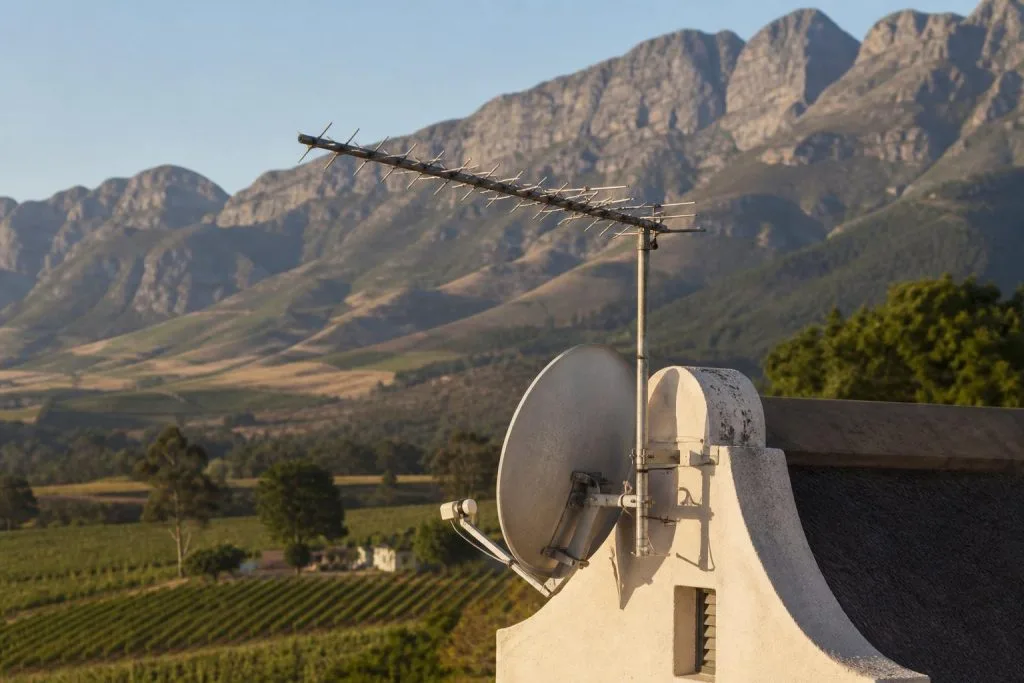
Stand in the garden with a pair of binoculars or your phone's zoom. Look for these:
- Orange streaks or bubbling paint on the wall bracket, pole or bolts.
- An LNB arm that droops, twists or sits off centre.
- Dents or pitting on the face of the dish.
- The dish shaking visibly when the wind picks up.
- Cable hanging loose, or a cracked cover on the LNB.
- A bracket pulling away from the wall, with cracked plaster around it.
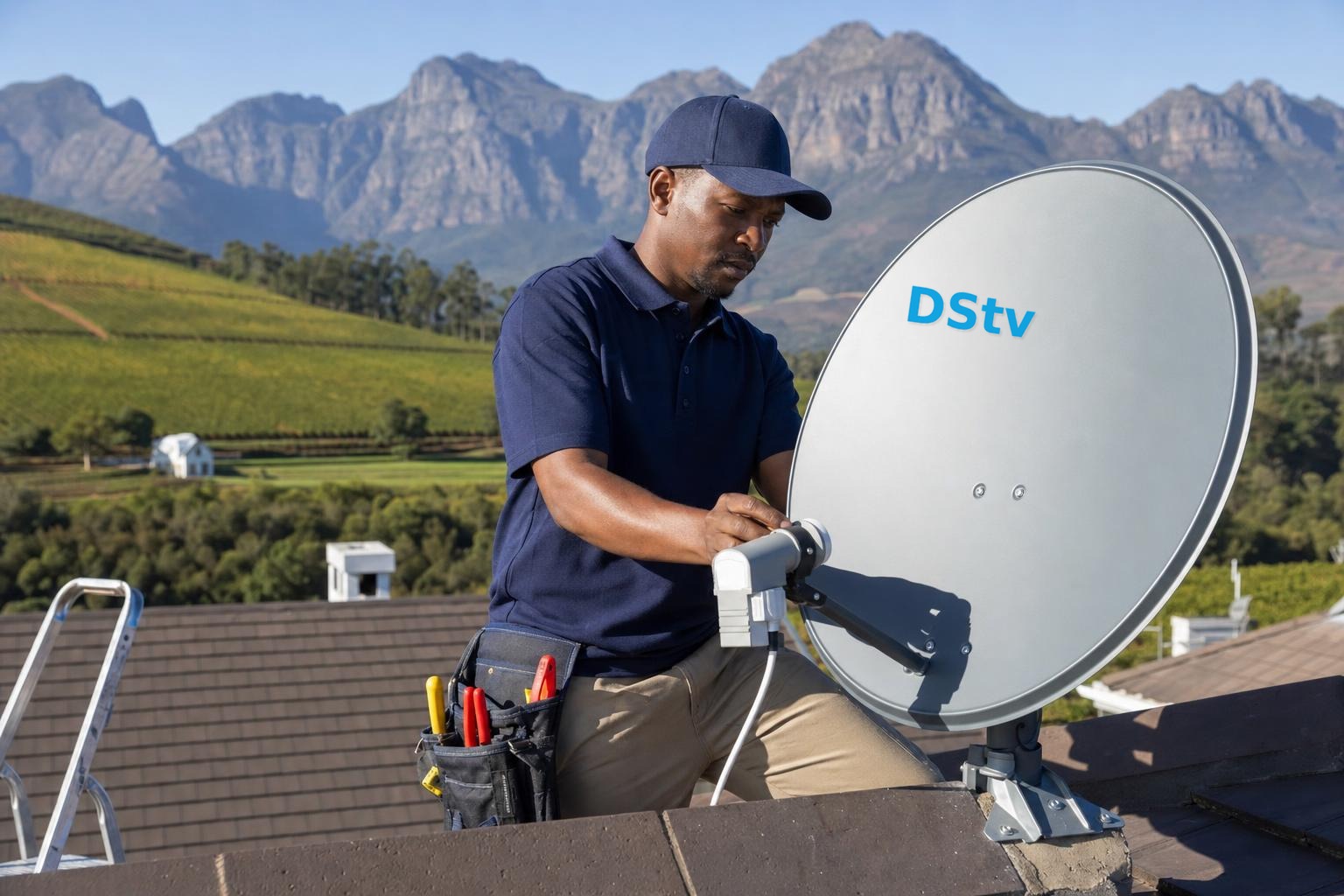
Safety first: Do all of this from the ground. Don't climb a ladder or get onto the roof to tighten bolts or bend the arm back. Wet tiles and old roof sheets in the valley are slippery, and one wrong turn of a bolt loses the alignment anyway.
If you spot one or more of these, book satellite dish alignment before the next big front comes through. A small fault is cheaper to fix than a dish that's swung right off target.
Rust: where it starts and why it matters
Rust nearly always starts at the bolts and the joint where the arm meets the dish. Winter cloud sits in the valley for days, so metal stays damp long after the rain stops. Older cottages in Bo-Dorp often still carry dishes fitted many years ago, and the cheap zinc coating on those bolts has long gone.
Surface rust or deep rust?
A light orange bloom on a bolt head is mostly cosmetic. Flaking metal, holes or a bracket that has thinned out is a different story. That kind of rust lets the whole dish sag slowly, and it can fail completely in a strong wind.
Rust on the dish face matters too. Pitting scatters the signal instead of focusing it onto the LNB, so your margin for bad weather shrinks.
Bent LNB arms
The arm holds the LNB at the exact focal point of the dish. Knock it by a few millimetres and the signal falls away sharply. We see arms bent by painters' ladders, falling oak branches, gutter cleaners and the odd heavy bird landing on the LNB.
Bending an arm back by hand rarely works, because the metal stays weak at the kink. A proper DStv dish LNB arm replacement, followed by a fresh alignment on a signal meter, is the lasting fix. If the LNB itself took a knock, our guide to Smart LNB faults shows what to look for.
Loose bolts and a wobbly mount
DStv comes from the Intelsat 20 satellite at 68.5 degrees East, so dishes here point roughly north-east and fairly high. In a narrow valley ringed by peaks, many dishes already have a tight view past the mountains. A tiny shift from a loose bolt can push them out of that window.
The giveaway is signal that drops in wind but comes back when it's calm. Storms rattle mounts loose over a few winters. Our post on signal loss in Winelands storms explains how wind and rain work together.
Need a hand in Franschhoek?
Tell us what you need or what your screen shows. We give you a clear price before we drive out.
How do I know if my satellite dish is faulty, or is it something else?
Not every signal problem is the dish. This table helps you narrow it down before anyone drives out.
| What happens | Dish to blame? | Other likely cause |
|---|---|---|
| E48-32 on every channel | Possibly, if it moved or the LNB failed | Damaged cable or a loose connector |
| Drops in light rain | Likely, alignment has little margin | Very heavy rain can affect any dish |
| Strength fine, quality low | Likely, alignment or LNB | Water inside a connector |
| Drops only when windy | Yes, loose bolts or a weak bracket | Rarely anything else |
| Only one TV in the house fails | Unlikely | That room's cable or decoder |
| E16 message | No | Subscription or authorisation |
Quality matters more than strength, so read both. Our explainer on signal strength versus quality shows where to find the numbers. For the dreaded no-signal message, see the common E48-32 causes.
Safe checks before you call us
- Switch the decoder off at the wall for a minute, then back on.
- Check that the cable at the back of the decoder is pushed in and screwed tight.
- Open the signal screen and note the strength and quality readings.
- Write down when drops happen: in wind, in rain or at a set time of day.
- Take a zoomed photo of the dish from the garden to send to us.
Those notes save time on site. If none of this fixes it, call a technician for DStv signal repairs rather than living with a flickering picture.
Repair, realign or replace a faulty satellite dish?
Realign only
If the dish is sound but has moved, tightening and realigning on a meter is enough.
Replace parts
A bent arm, rusted bolts or a cracked LNB can be swapped without changing the whole dish. A Smart LNB retails from around R399 to R499 at the time of writing, before fitting.
Replace the dish and bracket
When the bracket is rusted through or the face is badly pitted, a new dish makes more sense. As a guide, a standard installation budgets from around R850 to R1,400 at the time of writing, and harder roofs or long cable runs can cost more. Our dish price guide breaks down the parts, so ask our team for a current quote.
Keeping a dish healthy in the valley
Guest farms near La Motte and Wemmershoek often have dishes on outbuildings at the end of long driveways, where nobody looks at them for months. Lock-up-and-go homes in the village are the same. A quick look from the ground after every winter storm catches trouble early.
Technician tip: Take a photo of your dish when it's working well. If you ever suspect a problem, compare the two shots. A drooping arm or a tilted dish jumps out straight away.
Our team handling DStv installation in Franschhoek uses stainless or galvanised fittings on coastal and damp sites, and we work to MultiChoice installation standards. We cover Groendal, Simondium and the farms in between too.
Book a dish check in Franschhoek
Send us a photo and a short note on what the picture is doing, and we'll quote before we drive out. Use our contact page to arrange a visit.
Talk to our Franschhoek team
We work across Franschhoek, La Motte, Groendal, Wemmershoek, Simondium and nearby. Call or WhatsApp us and we will tell you the practical next step.
Faulty satellite dish: FAQs
How do I know if my satellite dish is faulty?
Look for rust on the bracket and bolts, a bent or drooping LNB arm, and a dish that moves in the wind. On the decoder, low signal quality or drops in wind and light rain point to the dish. Check from the ground only and let a technician confirm it with a meter.
Can a faulty satellite dish cause the E48-32 error?
Yes. If the dish has moved, the arm is bent or the LNB has failed, no signal reaches the decoder and E48-32 appears. A damaged cable or loose connector causes the same message, so a technician tests each part before replacing anything.
Do satellite dishes need replacing?
Not often. A well-fitted dish can last many years, but rusted brackets, pitted faces and corroded bolts eventually make replacement the better choice. Often only the arm, LNB or fittings need swapping, which costs less than a full new dish.
How do I know if my LNB is faulty?
A faulty LNB often shows as low signal quality even when the dish looks straight, or no signal at all. Cracks in the cover or water inside are clear signs. A technician tests it with a meter, because cable faults look very similar on the decoder.
Is it worth fixing a rusty dish on an older Franschhoek cottage?
If the rust is only on bolts and fittings, replacing those and realigning is usually worth it. If the bracket or dish face has rusted through, a new dish is safer and more reliable. We'll tell you honestly which applies after a look.
Need a DSTV technician?
Same-day DSTV installation, signal repair and Explora setup across Franschhoek and the Cape Winelands.