The quick answer: what should you budget?
In 2026, a loose satellite dish reflector suitable for a normal South African home installation is usually in the region of R350 to R700. That number is useful, but incomplete. A working installation also needs a bracket or pole, an LNB, coaxial cable, connectors and accurate alignment.
A basic parts bundle can therefore fall around R750 to R1,500, depending on dish size and what is included. For a complete, professionally fitted residential dish installation, a practical planning range is roughly R1,500 to R3,000. Longer cable runs, high roofs, non-standard brackets and difficult mounting surfaces cost more.
Those are market ranges, not a tariff. The phrase “DStv dish price” is used for three different things: the metal reflector alone, a boxed hardware kit, and a fully installed system. Make sure you are comparing the same thing. Monthly viewing fees are separate; see the 2026 DStv packages and prices for subscription costs.
A dish on its own cannot deliver a picture
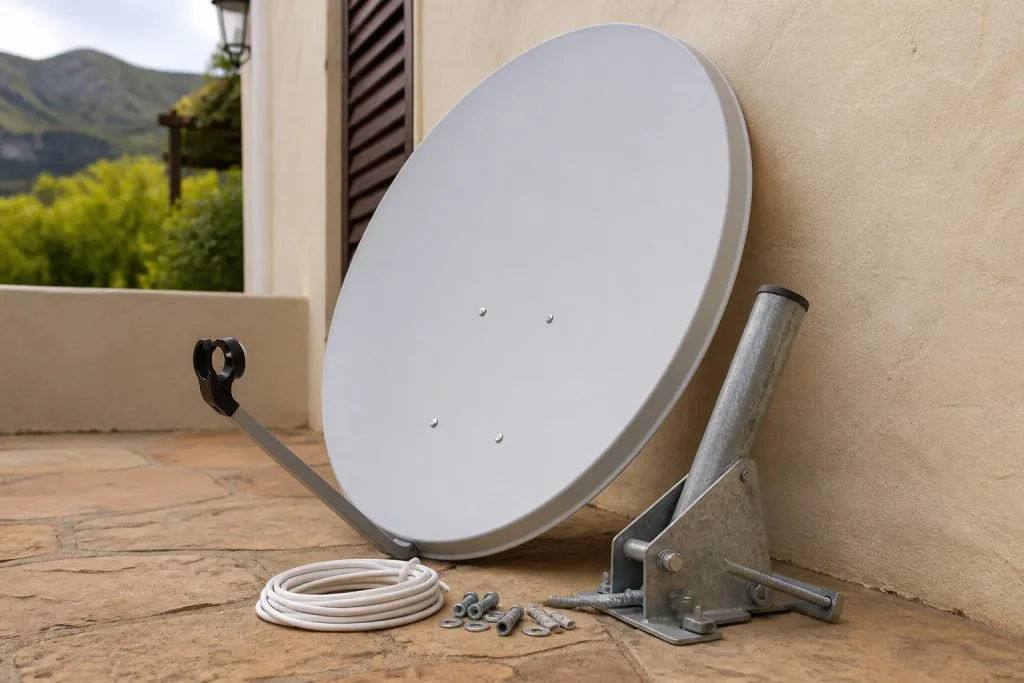
The reflector is only the most visible piece. It gathers the satellite signal and directs it toward the LNB on the end of the arm. The LNB converts that signal for the decoder, while the cable carries it indoors. Even good components perform badly when the dish is a few degrees off target.
A typical residential kit may contain:
- a 60 cm, 80 cm or similar approved reflector;
- a wall bracket, mast or pole and mounting hardware;
- an LNB appropriate for the decoder arrangement;
- coaxial cable and weatherproof connectors;
- clips or conduit for a neat cable route; and
- earthing or surge-related hardware where required by the site.
Retail kits differ. Some include a universal LNB, others a Smart LNB, and some are dish-and-bracket bundles with no cable. Read the contents list rather than trusting the product photograph.
Typical component costs in South Africa
The reflector
Allow about R350–R700 for the dish itself. Heavier or larger reflectors can cost more. Very cheap second-hand dishes may be bent around the rim or distorted at the mounting points. Small damage that looks cosmetic can make precise alignment difficult.
Wall bracket or pole
A standard bracket commonly adds roughly R180–R450. Special chimney mounts, long stand-off brackets or fabricated poles are priced differently. The correct mount matters in Franschhoek because winter wind loads a dish like a sail.
LNB and small hardware
An ordinary universal LNB may be cheaper, while a DStv Smart LNB often sits around R450–R750. Bolts, connectors, clips and sealant are individually inexpensive but still form part of the real kit cost.
Cable
Cable pricing depends on length and quality. A short, direct route is modest. A long run around a building, through a ceiling or in protective conduit adds both material and labour.
Why installed quotes vary so much
Two houses on the same street can need entirely different work. A technician first needs a clear north-easterly line of sight toward the satellite. Trees, neighbouring roofs and architectural features can rule out the easiest mounting position.
Wall type also matters. Sound masonry offers a firm fixing; old plaster, stonework and timber details need care. On farms and estates outside the village centre, travel time and long cable routes can affect the price. Double-storey roof work takes longer because safe access cannot be treated as an optional extra.
Alignment should be measured at the dish and confirmed at the decoder. A quote that includes hardware but no commissioning leaves the most important part unfinished.
Dish-only replacement versus a new installation
If a reflector is rusted or bent but the bracket, LNB and cable are still sound, replacing only the dish can save money. The installer should inspect the whole assembly. Rust around bolts, movement in the mast or water in a connector may make partial replacement poor value.
A new installation makes more sense when the existing mount is loose, the cable has deteriorated, the dish is too small for the site or the setup is being changed for an Explora or XtraView arrangement. Reusing good components is reasonable; reusing questionable ones merely moves the next call-out closer.
Can you buy a dish and fit it yourself?
Ground-level DIY installation is technically possible, but accurate alignment is less forgiving than it appears. Phone compass readings are affected by metal nearby, and signal strength without good signal quality can still produce unstable viewing. Drilling into a wall also carries waterproofing and structural risks.
Roof installation should be left to someone with suitable access equipment. A saving on labour is not worth cracked tiles, a leaking fixing point or a fall. For a measured quote that includes mounting and commissioning, arrange a satellite dish installation in Franschhoek.
How to compare quotes fairly
Ask for the dish size and whether the bracket, LNB, cable length, connectors, travel and decoder test are included. Confirm whether the stated amount includes VAT where applicable. Check the warranty on the hardware and the workmanship.
Be wary of a price that assumes every site is identical. A reputable installer can give a working range by phone, but the final amount should reflect the actual mounting point and cable route. Photos of the wall, roofline and existing hardware can make the initial estimate more useful.
Buying second-hand: cheap, sometimes costly
Used dishes are easy to find because subscribers move or cancel. A straight reflector with a solid mount can be reused. Inspect the rim, arm and bolt holes, and do not assume the attached LNB still works. Old coax that has lived outdoors for years is rarely the part worth saving.
The largest risk is paying someone to install marginal hardware and then paying again for a service call. For a permanent home setup, new mounting hardware and cable are normally the sensible place to spend.
Frequently asked questions
How much is a DStv satellite dish in South Africa?
The reflector alone is commonly about R350–R700 in 2026. A hardware kit may be around R750–R1,500, while a normal complete installation often totals roughly R1,500–R3,000.
Does the dish price include a decoder?
Usually not. Retail dish kits and installer dish quotes normally exclude the decoder and DStv subscription unless these are specifically listed.
What size dish does DStv use?
Common home installations use approved dishes around 60–80 cm, but the right choice depends on equipment, location and signal conditions. An installer should select and align it for the site.
Can an old DStv dish be reused?
Yes, if it is straight, firmly mounted and correctly positioned. The LNB, cable and connectors must be checked separately because they may have weathered even when the dish looks sound.
Based in Franschhoek or the surrounding Winelands? We install and align satellite dishes, and fix the alignment and weatherproofing faults behind most signal loss in the valley. See our dish installation and alignment service, or start at DStv Franschhoek for everything we cover across the valley. Call 079 754 5527 or request a free quote.
Need a DSTV technician?
Same-day DSTV installation, signal repair and Explora setup across Franschhoek and the Cape Winelands.