The satellite dish is the foundation of your whole DSTV setup: get it wrong and no decoder, package or fancy TV will save the picture. This guide explains what dish installation and alignment involves, what it typically costs in Franschhoek and the Winelands, and why a job that looks simple is where the difference between amateurs and professionals really shows.
What “installation and alignment” actually means
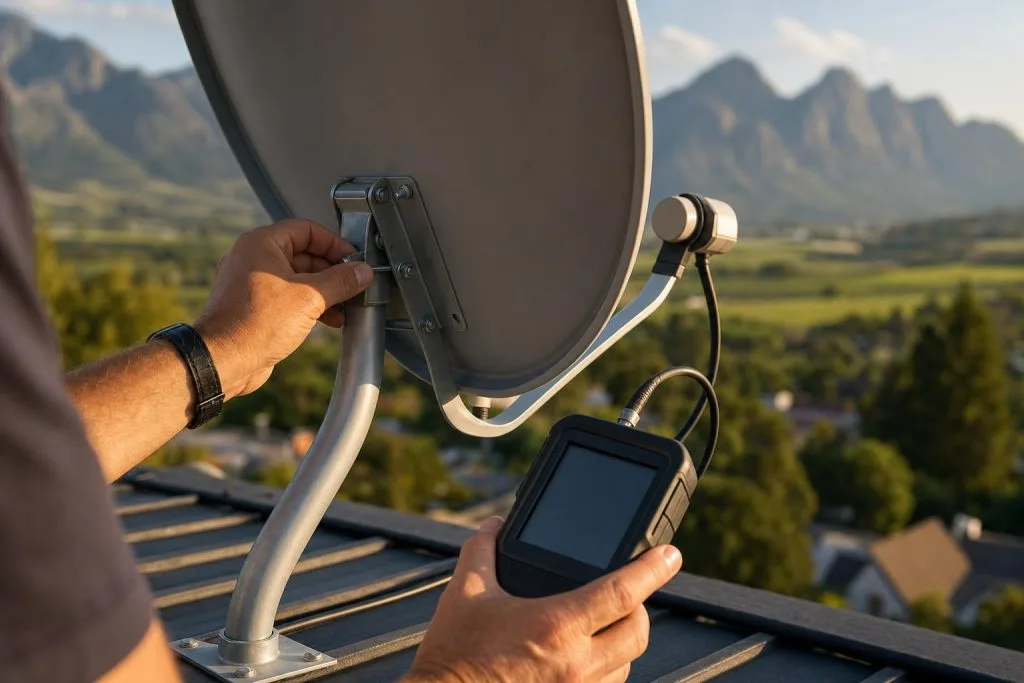
A dish install is two jobs in one. First, mounting: fixing a bracket and dish to a wall or pole with clear, unobstructed line-of-sight to the satellite. Second, alignment: adjusting the dish’s azimuth, elevation and LNB skew until it locks onto the strongest possible signal. Alignment is measured, not eyeballed: a proper installer uses a calibrated satellite meter reading signal strength and quality, not the rough signal bar on your TV. That last 5% of signal quality is exactly what keeps your picture up during a storm.
Typical dish costs in the Winelands (2026)
As a budgeting guide across Franschhoek, Paarl, Wellington and Stellenbosch:
- Realign an existing dish (knocked out by wind, or picture pixelating): usually R350–R650.
- Supply and mount a new dish with alignment: typically R450–R900 depending on dish size, mounting height and wall type.
- Replace a corroded dish, bracket and LNB: more, because it’s new hardware plus the labour, but it’s a one-time fix rather than repeat callouts.
A dish rarely lives on its own: if you’re setting up from scratch, it forms part of a full DSTV installation, and the dish work is bundled into that quote.
What affects the price
Height and access are the big ones. A single-storey wall mount is quick; a dish that needs to go high on a double-storey or onto a steep tiled roof takes more time and safety equipment. Wall material matters too: the stone and face-brick of many older Franschhoek homes and estates is slower to drill cleanly than plaster. And the dish position itself: if the only clear line-of-sight is on the far side of the house, the longer cable run adds cost.
Why alignment is where cheap installs fail
Almost every “my DSTV keeps pixelating” callout we get in the Winelands traces back to alignment or weatherproofing on the dish. A dish that was aligned to “just working” instead of peak signal has no buffer: the first cloudburst or bit of dish movement drops it below the threshold and the picture freezes. Connectors that weren’t sealed with self-amalgamating tape let water into the cable, corroding it from the inside. Both are cheap to do right and expensive to ignore. If your dish is already giving trouble, that’s a signal repair rather than a new install.
Getting it done properly
Our dish work uses galvanised brackets, RG6 cable, sealed weatherproof connectors and calibrated-meter alignment as standard: the same on a quick realign as on a full mount. See the full scope on our dish installation and alignment page, or read up on what to check before booking any installer. We cover Franschhoek and the surrounding Winelands. For a firm quote, contact us or call 079 754 5527.
For a dish that is mounted and aligned right the first time, use our dish installation and alignment service.
Based in Franschhoek or the surrounding Winelands? We install and align satellite dishes, and fix the alignment and weatherproofing faults behind most signal loss in the valley. See our dish installation and alignment service, or start at DStv installation in Franschhoek for everything we cover across the valley. Call 079 754 5527 or request a free quote.
Need a DSTV technician?
Same-day DSTV installation, signal repair and Explora setup across Franschhoek and the Cape Winelands.