Where you put a home security camera matters more than how much it cost. A good camera in the wrong spot records the tops of heads, a glare-filled sky or an empty wall. In Franschhoek, with long driveways, early winter dusk and plenty of rain, placement makes or breaks the system.
Quick answer: Place a home security camera where people must pass: the front door, the gate and driveway, back and side doors, and the garage. Mount it high enough to be out of reach but low enough to see faces, under an eave for rain cover, and angled away from direct sun. Cover every entry point before adding extras.
Start with the doors people actually use
Burglars and visitors both come in through doors, so start there. Most homes need a camera on the front door, the kitchen or back door, and any sliding door to the garden.
Point the camera so it sees the person's face as they walk toward the door, not just the back of their head as they leave. A spot to one side of the door, looking slightly across the path, usually works best.
Older cottages in Bo-Dorp, the historic part of Franschhoek, often have deep stoeps or low verandas. A small dome under the veranda roof is out of the rain and still has a clear view of the step. If you'd like the spots planned for you, our home CCTV installation starts with a walk-around.
Home security camera placement for gates and driveways
On farms and smallholdings around La Motte, Wemmershoek and Simondium, the gate can be hundreds of metres from the house. One camera can't do both jobs well, so plan two zones.
- At the gate: a camera close enough to read a number plate and see a face at the intercom.
- Near the house: a wide view of where cars park and where the driveway meets the yard.
- Along the way: only add cameras if there's a second track or a shed worth watching.
Our post on planning camera coverage on farms goes deeper into larger estates and guest farms.
How high to mount a home security camera
Too low and anyone can knock it off or spray it. Too high and you'll only see hats and hair.
A good rule is just out of arm's reach, around the height of the gutter on a single-storey house. On a double-storey, mount it at the lower eave rather than the top one, so faces still show.
Tilt the camera slightly down, not straight at the ground. You want the whole body in frame from a few metres away, with the face clear as the person gets close.
Safety first: Mounting cameras at gutter height means working on ladders, often on uneven paving or wet ground. Running cable through roofs and connecting power also carries real risk. Please leave high mounting and mains wiring to a trained technician.
Light, rain and the valley's winter shadow
The mountains around the valley block the low winter sun early in the afternoon. Light fades quickly, so cameras spend more of the day relying on night vision than you might think.
- Avoid pointing cameras straight at the rising or setting sun, which washes out the picture.
- Check the view at dusk, not just at midday, before you fix the bracket.
- Keep bright security lights out of the frame so they don't blind the lens at night.
- Mount under an eave where you can, because heavy winter rain on the lens blurs every frame.
- Watch for creepers and vines on old walls, which grow into the view and set off motion alerts.
Need a hand in Franschhoek?
Tell us what you need or what your screen shows. We give you a clear price before we drive out.
Back yards, windows and outbuildings
Once the doors and gate are covered, look at the quieter sides of the house. Burglars like spots where neighbours can't see them.
A camera on a back corner can often cover two sides of the house at once. Look for ground-floor windows hidden by hedges, a garage side door, and storerooms or cottages away from the main house.
Outbuildings need power and a link back to the recorder. If the WiFi doesn't reach, our WiFi and network cabling service can run a proper link. Guest cottages with weak signal often have the same problem as the cameras, which we cover in fixing WiFi dead zones.
Indoor security cameras: where they help
Indoor cameras make sense in a passage that leads to the bedrooms, near the main entrance hall, or covering a safe. They're handy in lock-up-and-go homes that stand empty for weeks.
Respect privacy. Keep cameras out of bedrooms and bathrooms, and tell domestic staff, guests or tenants where cameras are. In guesthouses, keep indoor cameras to shared entrances and reception areas only.
Wired or wireless security camera: what placement allows
Your choice of camera changes where you can put it.
| Spot | Wired CCTV cameras | Wireless security camera |
|---|---|---|
| Front and back doors | Ideal, with a steady feed and power | Works well if the WiFi is strong at that wall |
| Gate at the end of a long driveway | Best choice, with cable run in conduit | Often too far from the router without a wireless link |
| Older cottage with thick walls | Needs careful cable routing | Handy, but thick walls can block the signal |
| Rented home or flat | More drilling and cabling | Easier to move when you leave |
A wireless security camera still needs power, either from a plug or a battery you'll have to charge. "Wireless" only means the video travels over WiFi. On farms without fibre, a Starlink installation can give you the internet you need for viewing cameras on your phone.
Technician tip: Before drilling, stand where the camera will go and take a photo or short video on your phone at the same height. It's a quick way to check the angle and spot blind corners.
Plan your home security camera layout in Franschhoek
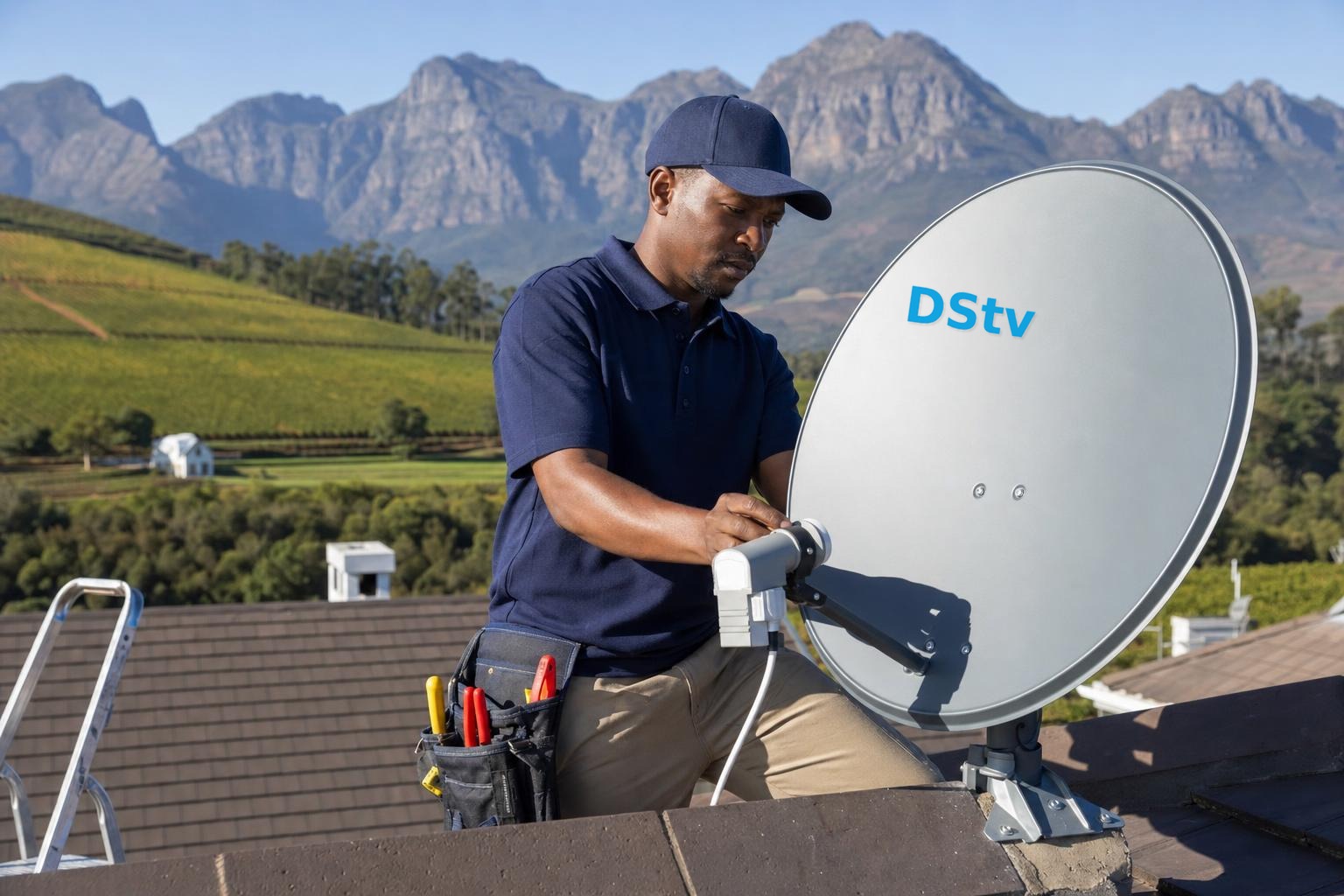
A few well-placed cameras beat a dozen badly placed ones. We'll walk your property with you, mark each spot and test the view day and night before anything is fixed. We also handle DStv installation in Franschhoek, so TV and cameras can share neat cable runs.
See our CCTV camera installation page for what we offer across Groendal, Mooiwater and La Provence. Call or WhatsApp 079 754 5527, or book a site visit online.
Talk to our Franschhoek team
We work across Franschhoek, La Motte, Groendal, Wemmershoek, Simondium and nearby. Call or WhatsApp us and we will tell you the practical next step.
Home security camera: FAQs
Where should I place home security cameras for best coverage?
Cover the places people must pass first: the front door, the gate and driveway, back and side doors, and the garage. Then add back corners and outbuildings. Each camera should see faces clearly as people approach, rather than looking down on the tops of their heads.
How high should a home security camera be mounted?
Mount it just out of easy reach, around gutter height on a single-storey home, and tilt it slightly down. Going much higher means you mostly see hats and hair. On double-storey homes, the lower eave usually gives a better view of faces.
Where should security cameras go on a Franschhoek farm or smallholding?
Put one camera at the gate close enough to read number plates and see faces, and another covering the parking area near the house. Add cameras on sheds, cottages and stores that are out of sight. Long driveways usually need cabled cameras or a proper wireless link.
Can I put security cameras inside my house?
Yes, in shared spaces like the entrance hall, passages and near a safe. Keep them out of bedrooms and bathrooms, and let domestic staff, guests or tenants know where they are. Indoor cameras are useful in homes that stand empty for long periods.
Can I install security cameras myself?
Simple plug-in indoor cameras are fine to set up yourself. Outdoor cameras usually need mounting at height, cable runs and power connections, which means ladders and mains wiring. It's safer to have a technician fit those and check the angles properly.
Need a DSTV technician?
Same-day DSTV installation, signal repair and Explora setup across Franschhoek and the Cape Winelands.