Effective CCTV in Franschhoek starts with a coverage plan, not a box of cameras. Guesthouses, farms and wine estates have different risks, lighting, distances and privacy responsibilities. The right design identifies what each camera must show, how footage will be stored and who can access it.
Start with incidents and evidence goals
List the events the system should help prevent or investigate: vehicle entry, gate access, deliveries, reception activity, equipment areas or movement near a perimeter. Then define the evidence needed. A wide overview may show that someone entered; identification at a gate needs a closer angle and suitable resolution.
Trying to make one camera identify faces, read plates and cover a huge courtyard usually produces weak evidence for all three.
Guesthouse camera planning
Prioritise entrances, parking, reception approaches and public circulation areas while respecting guest privacy. Avoid bedrooms, bathrooms and private leisure areas. Signage, access control and a clear retention policy help staff handle footage responsibly.
Place cameras so strong backlight from doors and windows does not hide faces. Reception staff should know who may view or export footage and how an incident is recorded.
Farm and wine-estate coverage
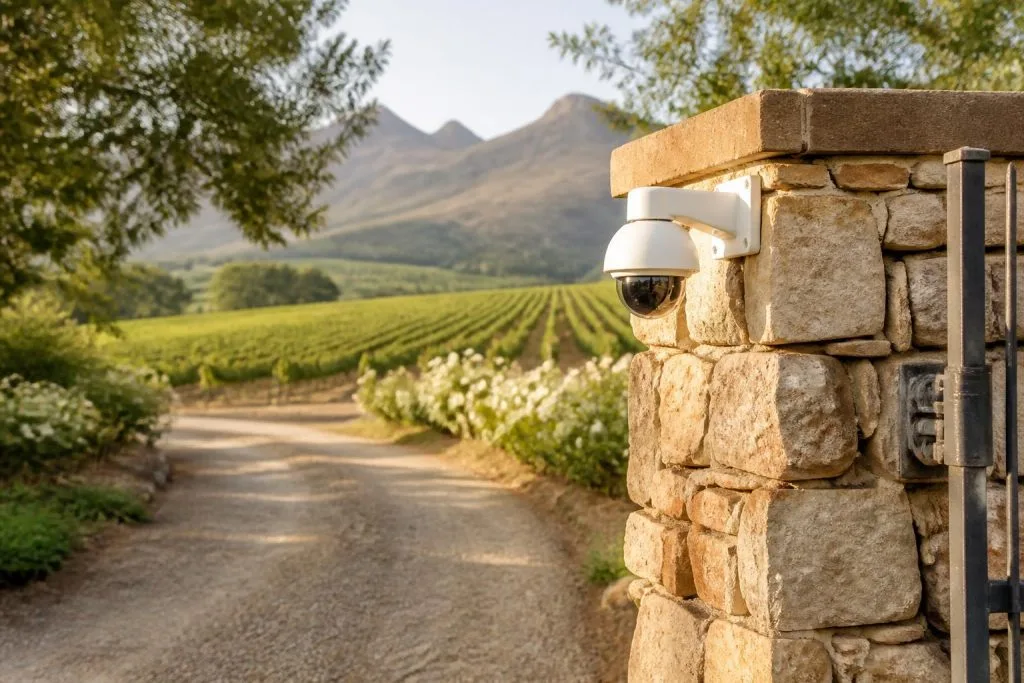
Long driveways, remote gates, stores, workshops and pump areas create distance challenges. A camera without reliable power and data is not useful, while a wireless link through trees or buildings may be unstable. Survey routes before choosing between cable, fibre, point-to-point wireless or a local recorder.
At vehicle gates, plan separate overview and identification views where necessary. Dust, insects, rain and vegetation also need maintenance allowances.
Night performance and lighting
Night image quality depends on lens choice, sensor performance, infrared range, scene lighting and reflective surfaces. A camera mounted too close to a white wall can illuminate the wall instead of the driveway. Headlights can overwhelm a poorly chosen angle.
Test the scene after dark, not only during installation in daylight. Controlled lighting often improves evidence more than adding extra low-cost cameras.
Recording, storage and remote access
Storage duration depends on camera count, resolution, frame rate, recording mode and drive capacity. Decide how many days are genuinely required, then size storage accordingly. Use surveillance-rated drives and protect the recorder from easy theft, heat and unauthorised access.
Remote viewing needs a stable, secured network. Change default passwords, keep software updated and provide individual access where supported. Our network cabling service can plan reliable links between cameras, access points and recorders.
A practical camera schedule
- Location and purpose of every camera.
- Required view: overview, recognition or identification.
- Day and night lighting conditions.
- Power and data route.
- Retention requirement and recorder capacity.
- Privacy masking, access and maintenance owner.
Frequently asked questions
How many cameras does a guesthouse need?
There is no useful number without a plan. Count evidence views, not buildings or rooms.
Are wireless cameras easier on a farm?
They reduce some cabling but still need power and reliable network coverage. Distance and obstructions must be surveyed.
Can CCTV read number plates at night?
It can when the camera, angle, exposure and lighting are designed for that task. A general overview camera may not.
How long should footage be kept?
Choose a justified operational period and follow applicable privacy obligations. Storage should be calculated from the actual system settings.
Book a coverage assessment
A site walk prevents blind spots, wasted cameras and unreliable links. Our CCTV installation service in Franschhoek covers homes, guesthouses, farms and estates. Call or WhatsApp 079 754 5527 with the property type and priority areas.
Privacy and operational responsibility
Camera ownership brings responsibility for the people recorded. Limit coverage to legitimate security purposes, use privacy masking where neighbouring or private areas enter the frame, and restrict footage access. Staff should know how to respond to a request or incident without casually sharing clips through personal messaging accounts.
Document who administers the recorder, who receives remote access and what happens when an employee leaves. Test exports before an emergency so time, date and camera labels are accurate. A system that records the wrong time or cannot export usable evidence has failed an important part of its purpose.
Based in Franschhoek or the surrounding Winelands? We plan camera coverage around what you actually need to see, then install and configure it. See our CCTV installation service, or start at our DStv installation service in Franschhoek for everything we cover across the valley. Call 079 754 5527 or request a free quote.
Need a DSTV technician?
Same-day DSTV installation, signal repair and Explora setup across Franschhoek and the Cape Winelands.