Can you actually find DStv signal with your phone?
Short answer: yes, to a point. There are satellite finder apps that use your phone’s compass and GPS to show roughly where in the sky a satellite sits from your exact spot in the Franschhoek valley, and DStv decoders have their own on-screen signal meters that tell you when a dish is pointed correctly. Put those two together and a patient, careful person can align a dish themselves. What your phone can’t do is match the accuracy of someone who’s pointed hundreds of dishes and knows the difference between “the app says you’re close” and “the beam is actually locked.” We’ll walk through both: the honest version of what’s possible, and where it runs out of road.
What satellite finder apps actually do
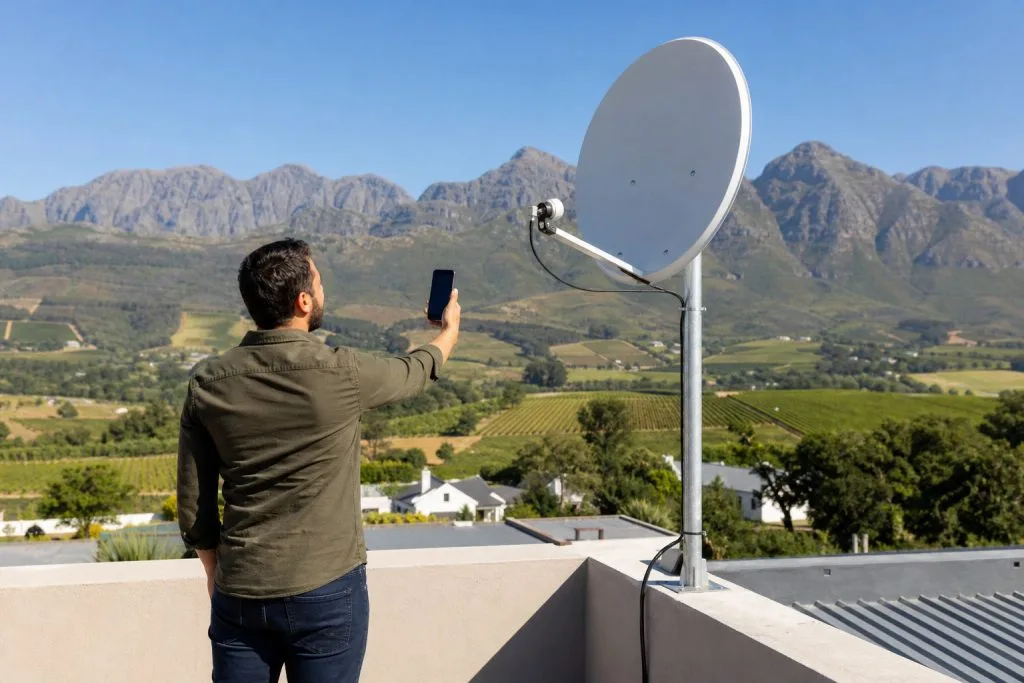
Apps like Satellite Director, Satellite Finder Pro and Dish Align (all available on Android and iOS) use your phone’s built-in compass, gyroscope and GPS to work out your exact latitude and longitude, then calculate the azimuth (compass direction) and elevation (angle above the horizon) you need for a chosen satellite. For DStv in South Africa, that satellite is Intelsat 20, sitting at 68.5°E: you’ll usually find it listed in the app simply as “IS-20” or “Intelsat 20.” Select it, hold your phone up like you’re taking a photo of the horizon, and the app overlays an arrow or a target reticle showing which way to swing the dish and how far to tilt it. Because Franschhoek sits at a specific latitude and longitude, the exact azimuth and elevation numbers will differ slightly depending on where in the valley you are: from the town centre out to Groot Drakenstein or La Motte, so let the app calculate it live for your spot rather than copying a number a neighbour gave you.
Using the decoder’s signal screens alongside the app
The app gets you pointed in roughly the right direction. Your decoder’s own signal meter is what confirms you’ve actually locked onto the satellite, and it’s far more precise than any phone sensor. Once the dish is roughly aimed:
- Power on the decoder and run the installation wizard up to the signal test screen, and leave it displaying signal strength and quality.
- Have a second person watch the decoder screen (or use a portable satellite meter if you have one) while you make small adjustments to the dish outside: DStv work is always a two-person job for exactly this reason.
- Loosen the dish mounting bolts just enough to move it, not so much that it flops.
- Sweep slowly left and right through a few degrees at a time, pausing a couple of seconds after each nudge: the signal reading lags slightly behind the physical movement.
- Once strength starts climbing, make smaller adjustments and start fine-tuning elevation (tilt) the same way.
- When both strength and quality bars are consistently high and stable, tighten the bolts fully without letting the dish shift, then re-check the reading one more time.
This is genuinely how professionals do the fine-tuning stage too: the difference is we’re not guessing at the rough direction first, because we already know it.
Why the app alone usually isn’t enough
A DStv dish has to hit a target in the sky that, from the ground, is only a fraction of a degree wide: the satellite itself is tiny at that distance, and being off by even one or two degrees can drop you from a strong lock to no signal at all. Phone compasses are notoriously unreliable for this kind of precision: they get thrown off by steel roof sheeting, nearby wiring, fence posts, even the metal in the dish bracket itself. It’s common for an app to point you confidently at a spot that’s five or six degrees out, which feels close but is nowhere near close enough. Add in Franschhoek’s terrain: mountains close in on three sides of the valley, and there’s a real chance the “correct” direction from the app is actually blocked by a ridge or a stand of oaks, something no app can tell you until you’re already up a ladder finding out.
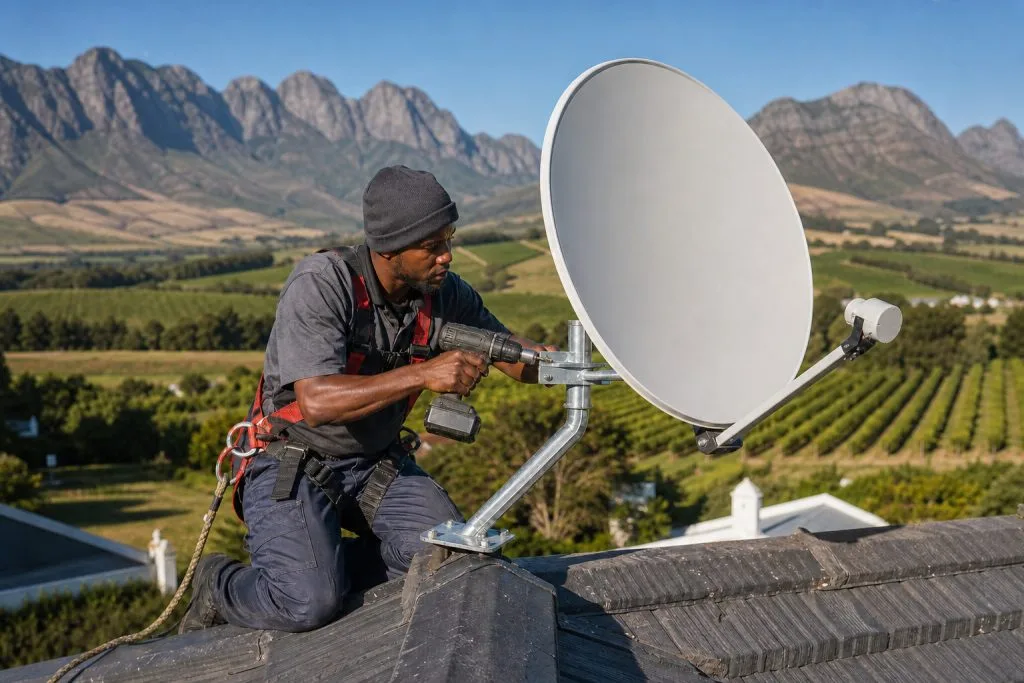
There’s also a safety side to this that’s easy to underestimate. Dishes usually sit on a roof edge, a gable, or a pole mount well above head height, and fine-tuning alignment means working up there for longer than a five-minute glance: often in wind, which the valley has no shortage of. That’s the point where the honest advice is: this is a two-person, properly-harnessed job, not a solo weekend project.
When it’s worth calling a professional instead
Phone apps are genuinely useful for two things: confirming a dish that’s already roughly aligned hasn’t drifted much, and giving you a rough starting direction if you’re troubleshooting alongside a technician on the phone. Where they fall short is anything that needs to be right the first time: a brand-new install, a dish that’s been knocked completely off its mount, or a signal that’s stayed at zero no matter how much sweeping you’ve done. If you’ve tried the app-and-decoder approach and you’re still stuck on low signal after a genuine attempt, that’s usually the sign the issue is something an app can’t diagnose: a faulty LNB, a damaged cable run, or an obstruction that’s grown or been built since the dish last worked properly. Our satellite dish installation and alignment service covers exactly this: proper alignment done with a calibrated meter, not a phone held up to the sky. For current package pricing once your signal is sorted, see our DStv packages and price list.
DSTV installers in Franschhoek: save yourself the ladder trip
If you’ve had a go with a satellite finder app and you’re still not landing a signal, or you’d simply rather not be the one up on the roof, DSTV Franschhoek installs and aligns dishes across the whole valley: from town out to Groot Drakenstein, La Motte and Wemmershoek. Call or WhatsApp 079 754 5527 and we’ll usually have someone out to you the same day.
Based in Franschhoek or the surrounding Winelands? We install and align satellite dishes, and fix the alignment and weatherproofing faults behind most signal loss in the valley. See our dish installation and alignment service, or start at DStv installers in Franschhoek for everything we cover across the valley. Call 079 754 5527 or request a free quote.
Need a DSTV technician?
Same-day DSTV installation, signal repair and Explora setup across Franschhoek and the Cape Winelands.